

Most marriage advice assumes both partners are equally invested and ready to work on the relationship. But that’s rarely how crisis actually looks. More often, one person is desperately searching for answers while the other has emotionally checked out. Or both people feel stuck, unable to see a path forward. The Hope Grid helps you understand exactly where you and your spouse are — and more importantly, what that means for your next steps.
The Four Quadrants of Hope
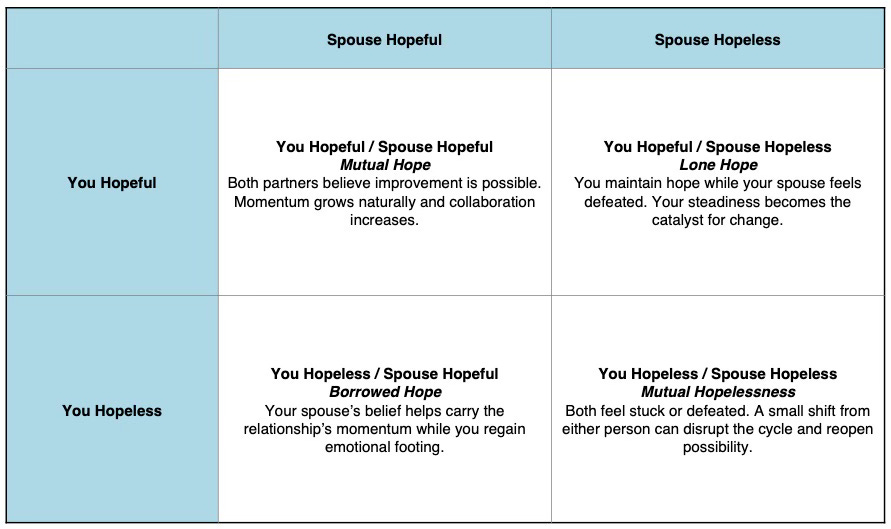
When it comes to saving your marriage, hope isn’t evenly distributed. You have a level of hope about your relationship. And your spouse has a level of hope about your relationship. Those two levels interact to create four distinct dynamics:
Hope Isn’t Something You Either Have or Don’t Have
Here’s where most people get it wrong: they treat hope like a light switch, either on or off. You’re either a naturally optimistic person or you’re not. Your marriage either feels hopeful or it doesn’t. And if you don’t feel hopeful right now, well, there’s not much you can do about that.
That’s not how hope actually works.
Psychologist Charles Snyder spent his career studying hope, and what he discovered changes everything. Hope isn’t a feeling that randomly shows up or disappears. It’s a formula. And like any formula, once you understand the components, you can rebuild it.
Hope = Goals + Pathways + Agency
Let’s break that down:
Goals — You need to be able to see something worth working toward. Not a fantasy version of your marriage, but a clear, meaningful vision of what’s possible.
Pathways — You need to identify actual routes to get there. Not vague advice about “communicating better,” but specific, actionable steps that make sense for your situation.
Agency — You need to believe you have the capacity to execute those steps. This is about proving to yourself, through small consistent actions, that you are capable of creating change.
When hope collapses in your marriage, it’s because one or more of these three components has broken down. You (or your spouse) can’t see a goal worth pursuing. You (or your spouse) can’t identify pathways that might work. Or you (or your spouse) don’t believe you have the capacity to execute even if you could see the way forward.
The good news? Each of those components is buildable. Hope isn’t something you passively wait to feel. It’s something you actively construct.
Hope Exists on a Spectrum — And You Can Move on It
In a marriage, you’re not just dealing with your own hope level. You’re dealing with two people, each on their own continuum of hopefulness. Neither is fixed in place. Your hope can grow stronger as you clarify goals, learn pathways, and build agency. Your hope can also erode if you stop taking action or keep hitting dead ends.
The same is true for your spouse. Their level of hope can shift up or down, based on what they experience, what they observe in you, and what feels possible to them in the moment.
This is critical to understand: hope isn’t static. It’s dynamic. And that means change is always possible, in either direction, for either person.
The Interaction of Two Hope Levels
Now we get to the real power of the Hope Grid. It’s not just about where you are or where your spouse is. It’s about how those two levels interact to create the actual dynamic you’re living inside.
Let’s walk through each quadrant:
Mutual Hope: You Hopeful, Spouse Hopeful
This is the easiest path forward, and you should recognize it as the gift it is. When both of you believe improvement is possible, momentum builds naturally. Collaboration increases. Small wins compound into bigger changes.
The danger here isn’t the difficulty of the work. It’s wasting your advantage by not acting deliberately. If you’re both feeling hopeful, this is the time to get the right structures in place. Use tools like the Un-Pause App or work through a structured program together. Don’t squander this window by coasting or assuming things will improve on their own.
Mutual hope gives you the best odds, but only if you channel it into intentional action.
Borrowed Hope: You Hopeless, Spouse Hopeful
Here’s an interesting observation: if you’re reading this and you genuinely consider yourself hopeless about your marriage, the fact that you’re engaging with material about saving it reveals something important. You still have someresidual hope, even if you can’t feel it.
It’s there… maybe hiding. But it is there.
The question isn’t whether hope exists for you. The question is: which component is missing?
Do you lack a clear goal? Maybe you can’t imagine what a good marriage with this person would even look like anymore.
Do you lack pathways? Maybe you’ve tried everything you can think of and nothing has worked.
Do you lack agency? Maybe you don’t believe you have the capacity, energy, or willingness to do what it would take, even if you knew what to do.
Right now, your spouse’s belief is carrying the relationship’s momentum while you regain your footing. That’s okay. Let their hope hold the space. Focus on identifying which specific element of your own hope formula needs rebuilding.
Lone Hope: You Hopeful, Spouse Hopeless
This is the reality for most people who end up in the Save The Marriage System. You’re desperately searching for answers while your spouse has one foot out the door. They’ve stopped believing change is possible. They may be checked out emotionally, or actively talking about separation, or simply going through the motions with no real investment.
Let’s be honest: this is harder. You’re working alone. You don’t have the natural momentum that comes from both people pulling in the same direction. And there’s a particular kind of pain that comes from caring deeply about something your spouse has given up on.
But harder doesn’t mean impossible. In fact, this is where understanding the Hope Formula becomes most powerful.
Your spouse’s hopelessness likely means one or more components of their hope formula has collapsed. They can’t see a goal worth pursuing with you anymore. They can’t identify pathways that feel workable. Or they don’t believe they have the capacity to do what it would take.
Here’s what matters: you can’t directly rebuild their hope. You can’t logic them into seeing a better goal. You can’t convince them that pathways exist. You can’t force them to believe in their own agency.
What you can do is change the input into the system. You can shift how you show up. You can stop doing the things that confirm their negative assumptions and start doing things that create unexpected evidence of possibility. You can build your own hope — with clear goals, effective pathways, and proven agency — and let that become quietly visible without demanding they reciprocate.
When you’re the Lone Hope person, your job isn’t to convince your spouse to feel differently. Your job is to maintain and build your own hope while creating conditions where their hope might eventually re-emerge.
That’s hard work. It requires tremendous patience and emotional maturity. But it’s also where the most dramatic turnarounds happen, because you’re doing something your spouse never expected: changing the entire dynamic by changing what you control.
The Critical Distinction: Hopeless About Your Marriage vs. Hopeful About Something Else
Here’s what makes this even more complex: there’s a massive difference between a spouse who is hopeless about the current marriage and a spouse who has found hope somewhere else.
A spouse who is hopeless about the marriage but hasn’t redirected their hope elsewhere is in a painful void. They can’t see how things could work with you, but they haven’t yet constructed a compelling alternative vision. This is actually the easier scenario to work with, because there’s space to rebuild.
But when a spouse has redirected their hope — toward an affair, toward a vision of single life, toward plans that don’t include you — the situation changes fundamentally. They’ve essentially built a new hope formula:
Goal: A life without this marriage
Pathways: Separation logistics, affair relationship, solo future planning
Agency: Active steps toward that alternative vision
Do you see how that makes such a big shift? Hopeless is likely to leave them feeling stuck, but wanting to not be stuck. Hopeful about something else, well that draws them toward that new reality. They are moving in a direction, toward their new hope (and away from the marriage).
This doesn’t mean the marriage is unsaveable, but it does mean you’re not just dealing with an absence of hope. You’re dealing with hope that’s been actively rebuilt in a different direction. That requires a different approach, a different timeline, and often deeper systemic work to disrupt the momentum they’ve already established.
Mutual Hopelessness: You Hopeless, Spouse Hopeless
When both people feel stuck or defeated, the momentum is toward dissolution. This is the hardest quadrant to work from because neither person has the energy or clarity to be the catalyst. In most cases, couples in this quadrant aren’t looking for help. They’re headed toward divorce.
I often hear from people in this quadrant for one particular reason: pressure from elsewhere (parents, children, friends, etc.) pushing them to try. Yet, there is no real energy to try.
But even here, a small shift from either person can disrupt the cycle and reopen possibility. Sometimes, all it takes is one person deciding to rebuild one component of their hope formula… identifying a single worthwhile goal, or learning one new pathway, or taking one small action that proves they still have agency.
That tiny shift can be enough to pull at least one person out of the Mutual Hopelessness quadrant, which changes everything.
What This Means For You
So where do you land on this grid right now?
More importantly, where does your spouse land?
And most importantly, what does that interaction mean for the path forward?
If you’re in Mutual Hope, get moving. Use the momentum you have. Put structures in place that will help you channel that shared belief into actual change.
If you’re borrowing hope from your spouse, focus on rebuilding your own formula. Identify what’s missing — goal, pathways, or agency — and start there.
If you’re holding Lone Hope while your spouse is hopeless, understand that you’re not trying to convince them. You’re changing what you control, building your own hope through clear goals and proven actions, and creating space where their hope might eventually re-emerge. Realize that there IS something you can do.
And if you’re in Mutual Hopelessness, remember: even a small shift matters. You don’t need to fix everything. You just need to rebuild one component of your hope formula and see what happens.
Hope isn’t something you wait to feel. It’s something you build, one piece at a time. And once you understand the formula, you can start building it today.
Are you ready to move forward?
👉 If you are the Lone Hope, grab my Save The Marriage System HERE.
👉 If you are at Mutual Hope, grab my Un-Pause App HERE
👉 And you can find more resources HERE